
Waste services
Lab pack services
Unknowns, shelf life expiries and mixed chemical inventories, identified and packed on site.
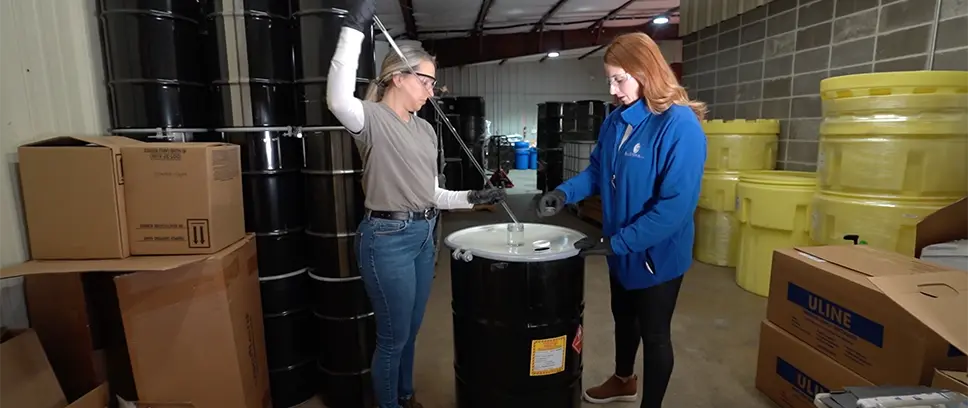
Lab packing identifies, segregates and packs small containers of chemical waste into drums with absorbent for consolidated disposal. A technical professional does the identification on site, which is what keeps unknowns from becoming rejected loads.
Source: 40 CFR 264.316 and 49 CFR 173.12(b)When lab pack is the right answer
- Laboratory shelf life expiries and surplus inventory
- Unlabeled or degraded containers of unknown contents
- Facility decommissioning and laboratory closures
- Discontinued product and reformulation clearouts
- Deregistered pesticides and agricultural chemical stocks
- School and university chemical stockroom cleanouts
How the work runs
On site, in sequence, by someone qualified to make the calls:
- Inventory every container, including the unlabeled ones
- Identify unknowns by hazard category testing where labels are missing
- Segregate by compatibility, never by convenience
- Assess for shock sensitivity, particularly peroxide forming ethers and picric acid
- Pack into drums with compatible absorbent and cushioning
- Assign waste codes, complete the manifest, and leave the documentation with you
Peroxide formers and dried picric acid are assessed before they are moved, not after. A crystallized ether bottle is a bomb disposal problem, not a waste problem.
Why a technical professional on site matters
A lab pack is a sequence of judgement calls made in front of a shelf. Is this compatible with that. Is this container stable enough to move. Is this crystallization on the cap a problem. Those decisions cannot be made from a spreadsheet afterwards.
It is also the point at which a P-listed item gets caught or missed. Missing one changes the generator status for the month, and finding it is what the person doing the packing is for.
Common questions
Can you handle completely unknown containers?
Yes. Hazard category testing establishes enough to pack and ship safely and correctly. Full analytical identification is rarely necessary and is expensive; hazard classification is what the packing and the codes need.
What about shock sensitive material?
Peroxide forming ethers, dried picric acid and similar materials are assessed before being handled. Where stabilization or specialist intervention is needed, that is arranged rather than improvised.
How long does a lab pack take?
A small stockroom is a day. A university department or a decommissioning can be several. The inventory stage is what sets the timeline, and a good inventory beforehand shortens it considerably.
Related services
Not sure how this applies to your site?
Send a profile, an old manifest, or photographs of the drums. A technical professional will tell you where you stand.
This page summarizes federal requirements and is not legal advice. State programs can be more stringent than the federal baseline. Verify against current federal and state regulations before acting. Last reviewed September 2026.