
Waste services
Acute hazardous waste disposal
P-listed material and the 1 kg threshold that changes your generator status.
Acute hazardous waste is P-listed discarded commercial chemical product and a small number of specific F listings. Generating more than 1 kg in a calendar month makes a site a large quantity generator for that month, regardless of other volumes.
Source: 40 CFR 261.33(e) and 40 CFR 262.13What counts as acute
- P-listed commercial chemical products discarded unused
- Off specification P-listed product
- Residues in containers that held P-listed chemicals
- Rinsate from triple rinsing a P-listed container, which is itself acute waste
- Spill residue and cleanup material from a P-listed chemical release
- F020, F021, F022, F023, F026 and F027, the dioxin bearing F listings
One kilogram is roughly two pounds. A single discarded container plus its rinsate can cross the threshold and move a site from VSQG to LQG for that month.
How we handle it
- Identification and verification before packaging, not after
- Segregation by compatibility with absorbent and cushioning
- Triple rinse protocol where containers are to be rendered empty, with rinsate captured
- Dedicated manifesting with acute codes clearly declared
- Routing to facilities permitted for the specific P codes
- Certificate of destruction returned per shipment
Where acute waste usually appears
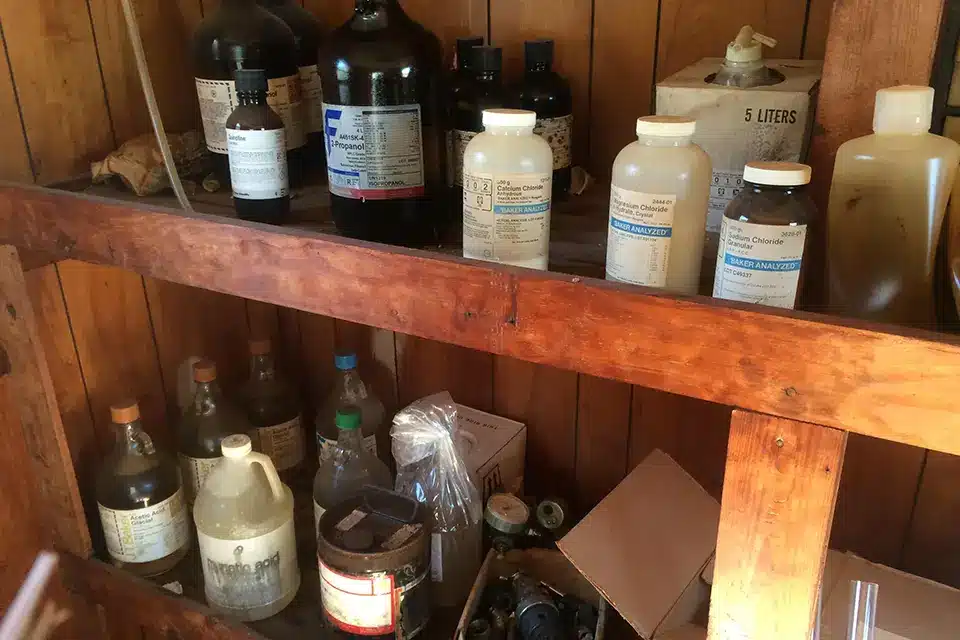
Almost always in inventory clearance rather than production. Laboratory shelf life expiries, discontinued product stock, deregistered pesticides and pharmaceutical actives. Sites that do not think of themselves as hazardous waste generators are the ones most likely to be holding it.
See lab pack servicesCommon questions
Why does 1 kg matter so much?
Because it moves your generator category. Exceeding 1 kg of acute waste in a month makes a site an LQG for that month, bringing a 90 day accumulation limit, contingency planning, training and biennial reporting with it.
When is a P-listed container empty?
Only after triple rinsing with a suitable solvent, under 40 CFR 261.7. The rinsate is itself acute hazardous waste and counts toward the 1 kg threshold.
Can you identify unknowns?
Yes. Identification is the first step and it is done on site where possible. Guessing at a P code is how a load gets rejected and a violation gets written.
Related services
Not sure how this applies to your site?
Send a profile, an old manifest, or photographs of the drums. A technical professional will tell you where you stand.
This page summarizes federal requirements and is not legal advice. State programs can be more stringent than the federal baseline. Verify against current federal and state regulations before acting. Last reviewed September 2026.